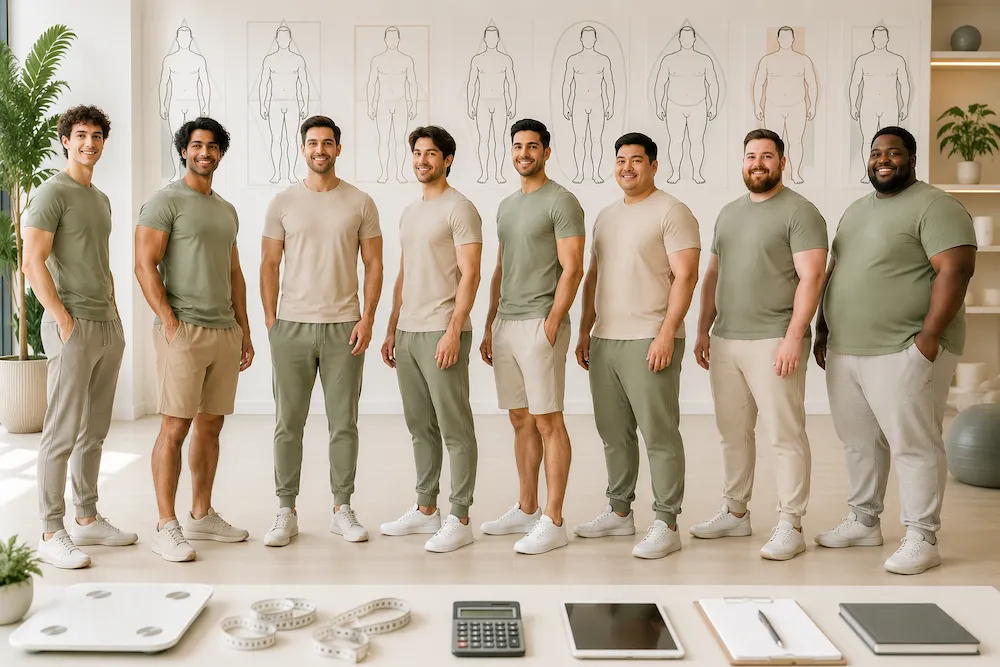
Most men buy clothes based on size alone — medium, large, extra large. But size tells you nothing about cut, proportion, or which silhouette actually works on your frame. A slim-fit jacket that looks sharp on a V-shape build looks completely wrong on a rectangle build. The same chinos that work on a trapezoid body sit incorrectly on an inverted triangle. The reason is always body shape — and once you know yours, buying the right clothes becomes significantly easier.
This guide covers all 8 male body shapes, how to measure yourself correctly, and how to use the free Male Body Shape Calculator on PRO Free Tools to get your exact result instantly. You will also get specific styling tips for Eastern and Western wear — matched to your body type.
Already know your measurements? Get your male body shape result in under 30 seconds — free, private, no signup.
What Is a Male Body Shape Calculator?
A male body shape calculator takes your shoulder, chest, waist, and hip measurements — runs them through a proportion analysis — and tells you exactly which male body shape classification you fall into. That result maps directly to styling principles that consistently work for your proportions.
The Body Shape Calculator for Men on PRO Free Tools classifies your body into one of 8 distinct male body shapes. Most tools offer only 5. The additional classifications matter because two men can both be broadly labelled “athletic” by a basic calculator but have meaningfully different proportions. The 8-shape system is more precise, and the styling guidance you receive is more accurate.
The tool works entirely in your browser. No account, no data upload, no signup. Your measurements never leave your device.
All 8 Male Body Types at a Glance
Before going shape by shape, here is a quick comparison so you can see where your shape sits relative to the others.
| Body Shape | Key Proportion | Best Style Direction | Common Mistake |
|---|---|---|---|
| △ V-Shape / Athletic | Shoulders much wider than waist | Fitted structured pieces | Wearing oversized tops that hide the build |
| ▭ Trapezoid | Shoulders slightly wider, balanced | Almost anything works well | Avoiding slim fits that would actually work |
| ▬ Rectangle | Shoulders, chest, waist all similar | Layering to create definition | Plain monochromatic looks with no contrast |
| ▽ Triangle / Pear | Hips wider than shoulders | Structured tops, simple bottoms | Tight trousers that emphasise hip width |
| ⬤ Oval / Round | Waist widest point | Vertical lines, V-necks | Tight waistbands, horizontal stripes |
| △ Inverted Triangle | Very broad shoulders, narrow hips | Volume below, simple above | Shoulder padding, boat necks |
| 🍎 Spoon | Hip shelf visible, lower heavy | Mid-rise bottoms, draped tops | High-rise waistbands over hip shelf |
| ⌛ Hourglass | Shoulders equal hips, waist defined | Fitted through waist | Boxy cuts that hide natural definition |
How to Measure Yourself — The Right Way
You need four measurements. Use a flexible sewing tape measure, stand straight, and wear a fitted t-shirt or underwear only. Measure each point twice and use the average for accuracy.
Shoulders
Measure across the back from the edge of one shoulder to the other. Stand relaxed — do not pull shoulders back.
Chest
Around the fullest part of your chest, tape parallel to the floor. Arms relaxed at your sides.
Waist
Narrowest point of your torso — about 1 inch above your navel. Breathe normally. Do not suck in.
Hip
Widest point of your hips and seat. Feet together, tape parallel to the floor.
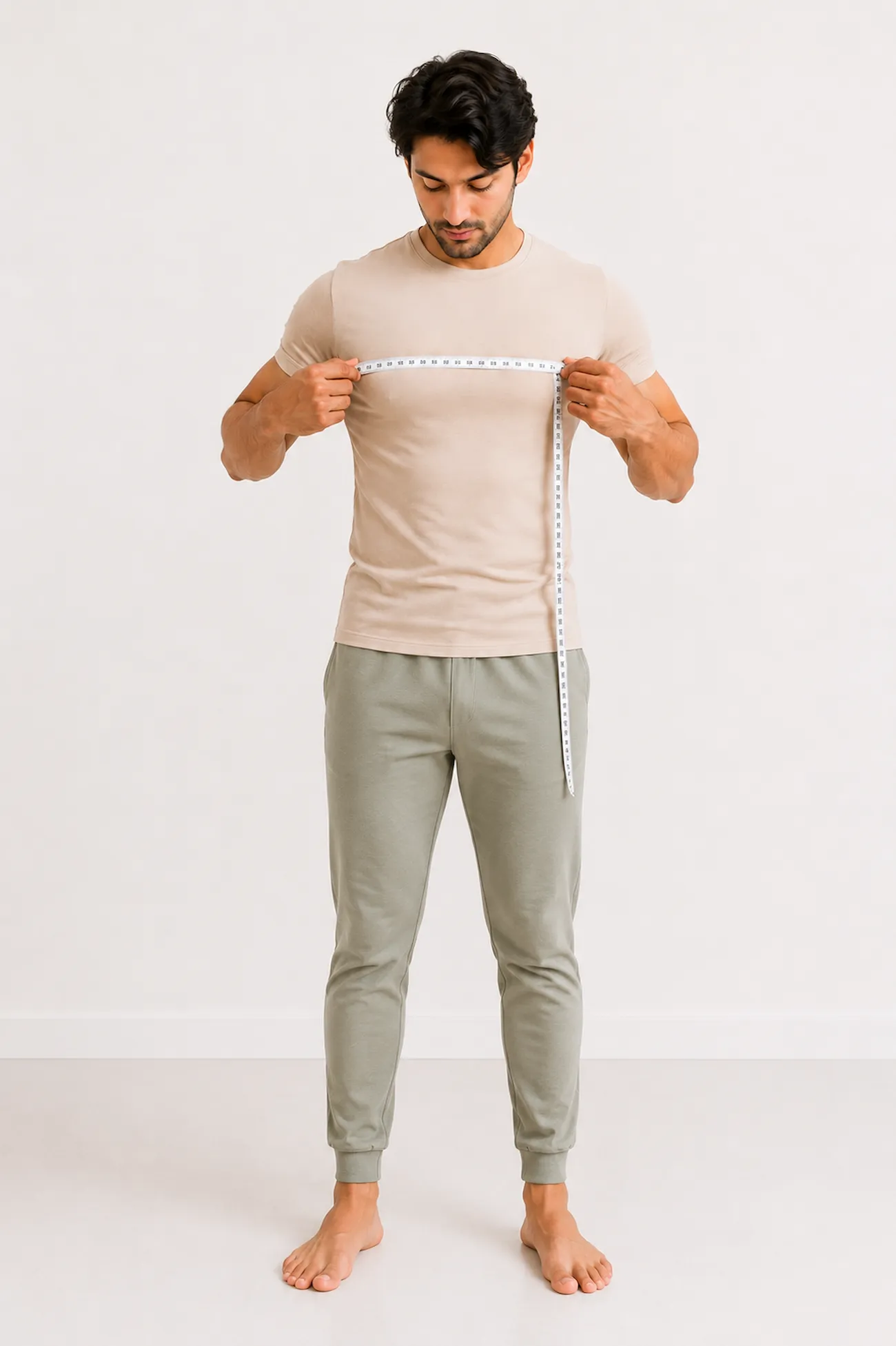
Never pull the tape tight. A too-tight measurement skews your ratios and can shift your classification by a full shape category. The tape should sit flat against your body with no gap — but no compression either.
V-Shape, Trapezoid, Rectangle and Triangle — Explained
V-Shape / Athletic
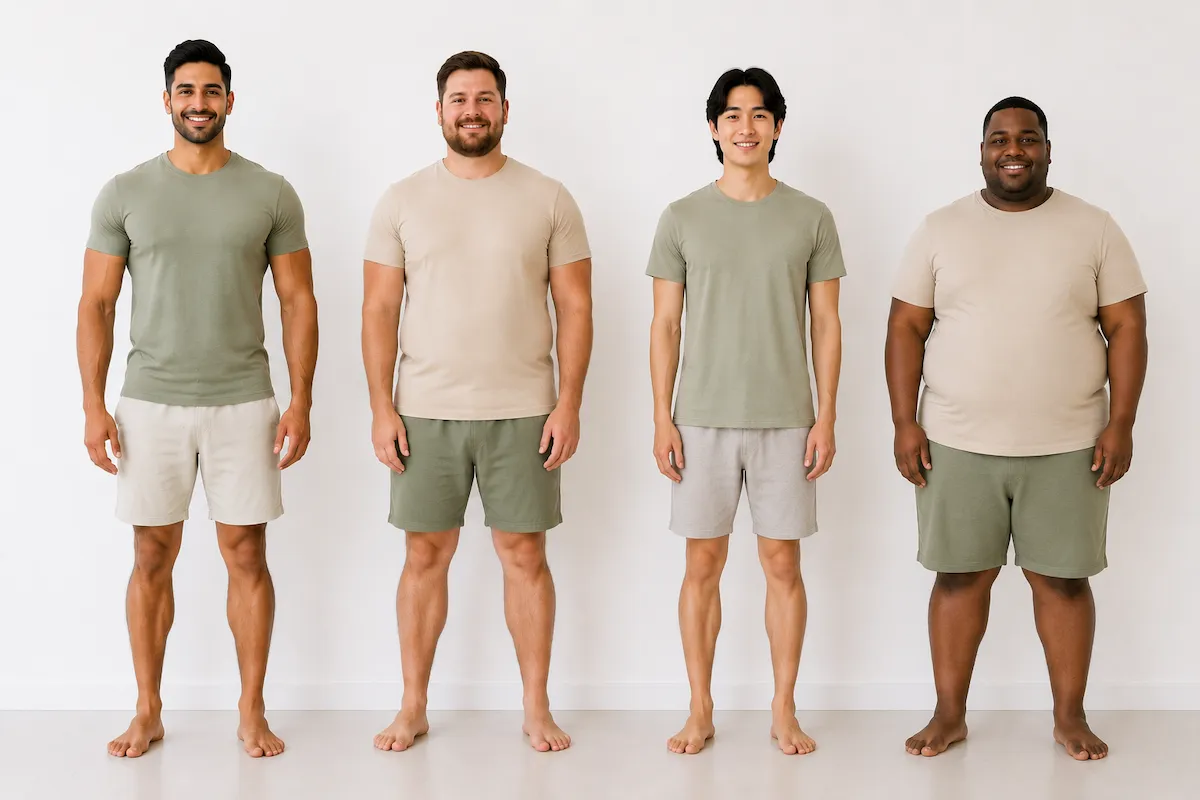
Your shoulders are significantly wider than your waist — typically by more than 10 inches. The silhouette is a clear V from shoulder to waist. This is one of the most common male body shapes in athletic builds. Clothes are generally designed with this proportion in mind, which means fitted cuts work very well on you.
The challenge is finding shirts with enough shoulder and chest room that still taper at the waist. Off-the-rack slim fits often gap at the chest or pull at the shoulders.
✓ What Works
- Fitted structured jackets
- Tapered slim trousers
- V-necks and crew necks
- Fitted polo shirts
- Structured kurta
✕ What to Avoid
- Oversized boxy tops
- Horizontal chest stripes
- Puffy or quilted jackets
- Wide-leg trousers
Trapezoid / Balanced
Your shoulders are slightly wider than your hips, with a reasonably proportional chest and waist. This is the most versatile male body shape — considered the ideal proportions by most fashion houses. Standard sizing tends to fit you well across the range.
The main challenge for Trapezoid shapes is not proportion — it is avoiding the trap of playing it too safe. Your proportions work with almost any cut, which means you can experiment with bolder fits and silhouettes that other shapes cannot pull off as easily.
✓ What Works
- Slim, regular, and relaxed fits
- Structured blazers and suits
- Straight and tapered trousers
- Fitted shalwar kameez
- Most necklines work well
✕ What to Avoid
- Extremely oversized silhouettes
- Shapeless, unstructured cuts
- Clothes that are too tight overall
Rectangle / Straight
Your shoulders, chest, waist, and hips are all within approximately 5% of each other. The silhouette is straight up and down with minimal taper. This is a very common male body shape, particularly for slim and lean builds.
The goal is creating the appearance of more shape — introducing visual contrast between the top and bottom half. Layering, texture, and structured pieces do this effectively.
✓ What Works
- Layered looks — jacket over shirt
- Horizontal chest details
- Textured fabrics and prints
- Wide-leg and straight trousers
- Embroidered kurta with belt
✕ What to Avoid
- Plain monochromatic outfits
- Very tight fitted pieces
- Shapeless loose cuts
- Vertical stripes head to toe
Triangle / Pear
Your hips are wider than your shoulders, with weight distributing more in the lower half. Less common in men than in women but more prevalent than most people realise. Clothes designed for standard male proportions — wider at top, narrower at bottom — often fit poorly off the rack.
The styling principle is visual balance — drawing attention upward to create the impression of broader shoulders relative to the hip.
✓ What Works
- Structured padded jackets
- Horizontal chest details
- Bold printed tops
- Dark slim bottoms
- Wide shoulder kurta
✕ What to Avoid
- Tight trousers emphasising hips
- Hip pocket detail
- Plain dark tops with bright bottoms
- Low-rise waistbands
Oval, Inverted Triangle, Spoon and Hourglass — Explained
Oval / Round / Apple
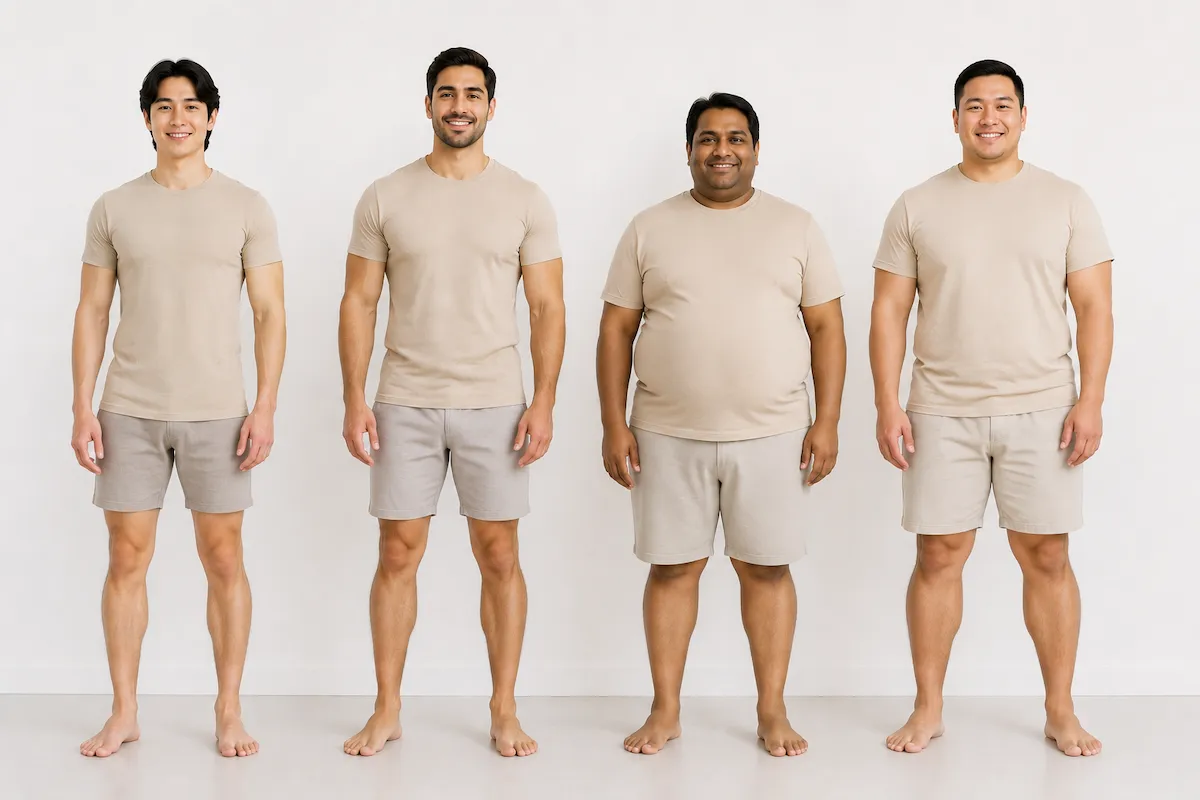
Your waist is the widest point of your torso — wider than both your chest and hips. Weight distributes primarily around the midsection. Legs are often slim relative to the upper body. This is a very common male body shape, particularly common after age 35.
Vertical lines are the primary tool. Anything that draws the eye up and down rather than across — V-necks, open collars, vertical prints — creates a more elongated silhouette.
✓ What Works
- V-necks and open collar shirts
- Vertical print shirts
- Dark straight trousers
- Long open cardigans
- Straight cut shalwar kameez
✕ What to Avoid
- Tight waistbands that dig in
- Horizontal stripes
- Tucked shirts that emphasise waist
- Short jackets ending at waist
Inverted Triangle
Your shoulders are very significantly wider than your hips — more extreme than the standard V-shape. Common in bodybuilders and men who carry weight in the upper body. Standard shirts are almost always too tight at the chest and shoulders, or too loose at the waist.
The goal is adding visual volume below the waist to balance the very broad upper body.
✓ What Works
- Wide-leg and palazzo trousers
- Flared hem trousers
- Simple fitted V-necks
- Straight cut shirts, untucked
- Straight shalwar with simple kameez
✕ What to Avoid
- Shoulder padding
- Boat necks and square necklines
- Horizontal chest stripes
- Skinny trousers
Spoon
A variant of the Triangle shape with a visible hip shelf — the hip measurement is noticeably larger than the chest, with a shelf-like silhouette at the hip bone level. Most basic calculators classify Spoon shapes as standard Triangle, which is why the PRO Free Tools calculator uses four measurements to detect this distinction.
The hip shelf responds better to soft, draped fabrics than structured cuts. Anything that cinches directly at the shelf tends to emphasise it.
✓ What Works
- Soft draped shirts and tops
- Mid-rise bottoms
- Flared and straight trousers
- Structured tops to balance
- Loose kurta with mid-rise shalwar
✕ What to Avoid
- High-rise waistbands over hip shelf
- Pockets directly on hip shelf
- Tight trousers
- Clingy fabrics below waist
Hourglass
Your shoulders and hips measure within 5% of each other, and your waist is noticeably narrower than both. Less common in men than in women but not rare — particularly in lean and athletic builds where muscle definition creates a visible waist taper.
Fitted pieces through the waist acknowledge and complement the natural definition you already have.
✓ What Works
- Fitted structured jackets
- Tapered trousers
- Fitted polo and crew necks
- Belted outerwear
- Fitted kurta with defined waist
✕ What to Avoid
- Boxy oversized tops
- Drop-waist cuts
- Shapeless unstructured pieces
- Elastic waistbands
Eastern and Western Wear — By Body Shape
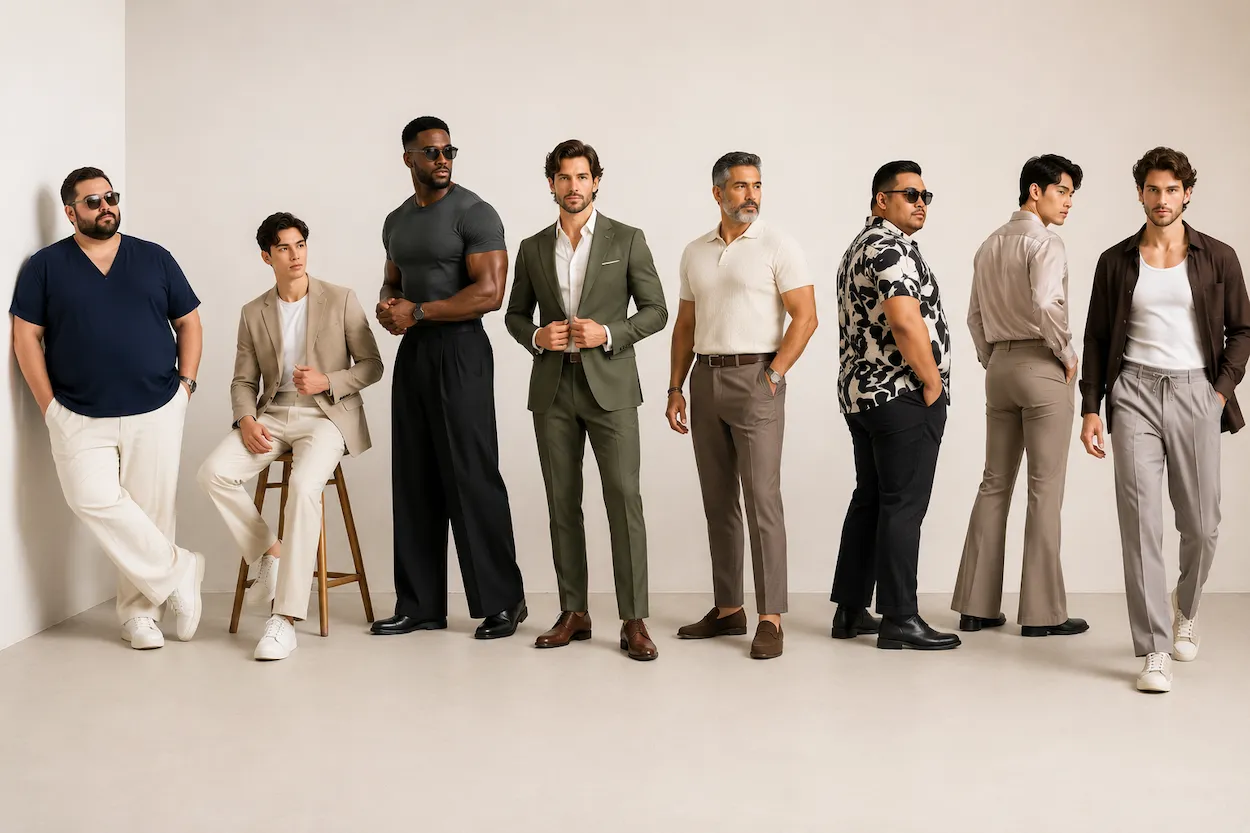
These styling principles apply regardless of size or age. They work with your proportions — not against them.
| Body Shape | Best Western Cuts | Best Eastern Cuts | Key Principle |
|---|---|---|---|
| △ V-Shape | Fitted suit, tapered trousers, slim polo | Fitted structured kurta, straight shalwar | Highlight the taper — already defined |
| ▭ Trapezoid | Slim or regular fit — almost anything | Fitted or straight kurta — versatile | Experiment freely — most cuts work |
| ▬ Rectangle | Layered jacket over shirt, textured fabrics | Embroidered kurta, belted shalwar kameez | Create definition with layers and texture |
| ▽ Triangle | Padded jacket, bold printed top, dark slim bottoms | Wide shoulder kurta, simple dark shalwar | Draw attention upward — balance the hip |
| ⬤ Oval | V-neck, vertical print shirt, dark straight trousers | Straight cut shalwar kameez, long open kurta | Vertical lines — elongate the silhouette |
| △ Inverted Triangle | Simple V-neck, wide-leg trousers | Simple kameez, straight shalwar | Add volume below — balance upper body |
| 🍎 Spoon | Soft draped shirt, mid-rise flared trousers | Loose kurta, mid-rise shalwar | Soft fabrics — avoid shelf emphasis |
| ⌛ Hourglass | Fitted jacket, tapered trousers, belted coat | Fitted kurta with defined waist | Acknowledge the waist — it is already there |
Body & Wellness Tools — Use Together
Use the Male Body Shape Calculator alongside these tools for a complete body proportion picture.
Body Shape Calculator for Men
Enter 4 measurements — get your exact male body shape instantly with styling guide.
Waist to Hip Ratio Calculator
Check your waist vs hip proportion — works with your body shape result.
Waist Height Ratio Calculator
Find out if your waist is proportionate to your height — instant result.
Body Shape Calculator
Female body shape — 8 classifications with full styling and outfit guide.
Common Questions
What is the most common male body shape?
Trapezoid and Rectangle are the two most common male body shapes globally. Trapezoid — shoulders slightly wider than hips with a balanced build — is often considered the standard male proportion that most menswear is designed around. Rectangle is the second most common, particularly in slim and lean builds where the chest, waist, and hips are all close in measurement.
How many male body shapes are there?
Most calculators identify 5 male body shapes. The PRO Free Tools Male Body Shape Calculator identifies 8 — including Spoon and Hourglass, which most tools miss entirely. The additional shapes are real, common, and have meaningfully different styling needs from the standard 5 classifications.
How do I measure myself for the male body shape calculator?
You need four measurements — shoulders, chest, waist, and hip. Use a flexible sewing tape, wear fitted clothing only, and measure each point twice using the average. The shoulder measurement goes across the back from one shoulder edge to the other. The chest measurement goes around the fullest part. Waist at the narrowest point above the navel. Hip at the widest point of the seat.
Can a man have an hourglass body shape?
Yes. The male hourglass shape is less common than in women but not rare — particularly in lean athletic builds where muscle definition creates a visible waist taper. In a male hourglass, the shoulders and hips are within 5% of each other with a noticeably narrower waist. Fitted structured pieces through the torso work best for this shape.
Does body shape affect which clothes fit correctly?
Significantly. Off-the-rack sizing is designed around an assumed proportion — typically a mild trapezoid build. If your proportions differ — very broad shoulders, wider hips, prominent waist — standard sizing will fit one area and not another. Knowing your body shape tells you which areas to prioritise when buying and which alterations to look for.
Does male body shape change with age?
Yes. The most common change is a shift toward Oval or Round as the waist measurement increases relative to chest and shoulders with age. Regular activity helps maintain proportion balance over time. The calculator is worth revisiting whenever your measurements change noticeably.
What is the difference between V-shape and Inverted Triangle?
Both shapes have broader shoulders than hips, but the degree differs significantly. V-shape has shoulders noticeably wider than waist — a proportional athletic build. Inverted Triangle is more extreme — very broad shoulders relative to very narrow hips, often seen in heavy upper-body builds. Inverted Triangle shapes specifically need volume below the waist, which V-shape builds generally do not.
How is male body shape different from BMI?
BMI compares total weight to height — it tells you nothing about where your body carries weight or how your proportions are distributed. Two men with identical BMI can have completely different body shapes. For clothing decisions, body shape is significantly more useful than BMI because it tells you which cuts and silhouettes actually work on your frame.
Published by PRO Free Tools — free browser-based calculators and AI tools. No signup, no data storage, 100% private.