Body Shape Calculator For Men
Enter four measurements. Get your precise male body shape classification instantly — private, accurate, on your device.
Enter your measurements on the left and tap Calculate to identify your shape from 5 classifications.
What Is the Body Shape Calculator for Men?
The Body Shape Calculator for Men on PRO FreeTools is a free, instant, and 100% private SaaS-grade utility that identifies your precise male body shape using three simple measurements: chest, waist, and hip. Unlike generic BMI tools, this calculator applies professional geometric ratio analysis — the same method used by fashion designers, master tailors, and personal style consultants worldwide — to classify your silhouette into one of 5 male body shapes: Inverted Triangle (V-shape), Trapezoid (athletic), Rectangle (straight), Triangle (pear), and Oval (round).
The tool works entirely inside your browser. No data is uploaded, no account is needed, no server ever sees your measurements. Every calculation runs in pure JavaScript, on your device, in real time. This is what a modern body shape calculator for men online should be — fast, private, scientifically grounded, and beautifully designed.
Whether you are shopping for tailored suits, planning your wardrobe, working with a tailor for kurta or sherwani, choosing the right blazer cut, or simply curious about “what body shape am I as a man” — this tool gives you a definitive, data-backed answer in under 30 seconds. The result instantly connects you to your ideal suit style, recommended outfits in both Eastern and Western wear, and color guidance tailored to your unique masculine silhouette.
How to Take Accurate Male Body Measurements
Your result is only as accurate as your measurements. Follow this professional guide for the best body shape calculator for men result — use a flexible sewing tape measure, wear minimal clothing or a fitted t-shirt, stand relaxed with feet shoulder-width apart, and breathe naturally. Never pull the tape tight. Measure each point twice and use the average for precision.

Fullest part of the chest, just under the armpits. Tape parallel to the floor across the back.
Narrowest part of the torso, approximately at navel level. Your natural waist.
Widest point of the hips and seat, typically at the hip bone level.
Optional bonus measurement. Shoulder to shoulder across the back for V-taper assessment.
How the Male Body Shape Algorithm Works
This body shape calculator for men uses a three-step ratio engine based on professional fashion industry standards. The chest-to-waist ratio is the primary signal, with hip-to-chest comparison as a secondary indicator. Here is exactly how it classifies your shape:
This algorithm gives you the mathematically correct classification based on your exact body geometric ratio — the same method used by professional men’s tailors and fashion stylists at brands like Tom Ford, Hugo Boss, and Sania Maskatiya.
Male Body Shape Classification Chart
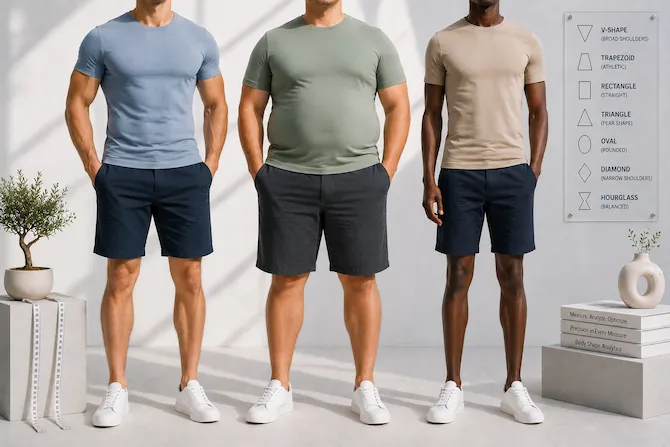
The five male body shapes detected by this body shape calculator for men, with defining ratio rules and key styling direction. Compare your result to understand exactly what your shape means and how to dress for it.

| Shape | Defining Ratio Rule | Key Styling Direction |
|---|---|---|
| 🔻 Inverted Triangle | Chest ÷ Waist ≥ 1.5 · Classic V-taper | Slim-fit trousers, fitted shirts, minimal shoulder padding |
| ⬜ Trapezoid | Chest ÷ Waist 1.3 to 1.5 · Athletic balanced | Most cuts work well — tailored slim fit is ideal |
| ▭ Rectangle | Chest ÷ Waist < 1.3 · Chest ≈ Hips · straight | Layering, structured jackets, horizontal stripe accents |
| 🔺 Triangle (Pear) | Hips 1%+ wider than Chest | Structured shoulders, dark-toned bottoms, vertical lines |
| 🟠 Oval (Round) | Waist equals or exceeds Chest | Vertical-line prints, tailored jackets, monochromatic outfits |
Your Body Shape & Suit Style Connection
The perfect suit is not about expensive fabric alone — it is about the right cut for your body shape. A master tailor will tell you: the suit silhouette must work with your geometric proportions, not against them. Here is how each of the 5 male body shapes pairs with its ideal suit cut:

| Body Shape | Recommended Suit Style | Why It Works |
|---|---|---|
| Inverted Triangle | Slim Single-Breasted 2-Button | Sharp cut emphasizes V-taper without exaggerating shoulders |
| Trapezoid | Classic Tailored 2-Button | Most versatile cut showcases natural athletic balance |
| Rectangle | Double-Breasted | Creates dimension and structure on straight build |
| Triangle (Pear) | Structured Shoulder Blazer | Sharp shoulder lines balance wider lower silhouette |
| Oval (Round) | Vertical Line Tailored Suit | Vertical pinstripes create refined slimming silhouette |
Tailor’s Master Guide for Men’s Body Shapes
Whether you visit a master tailor for custom Eastern wear or shop ready-made Western outfits, knowing your body shape transforms your wardrobe decisions. The cut, fabric, and silhouette that flatter your body are not opinions — they are measurable geometric relationships. This comprehensive guide gives you specific outfit recommendations for both Eastern (Pakistani, Indian) and Western men’s wear.

Eastern Wear Recommendations by Body Shape
Pakistani and Indian men’s wear — kurta, shalwar kameez, sherwani, achkan — offers tremendous silhouette flexibility. Here is what to ask your tailor for, based on your shape:
| Shape | Best Kurta Cut | Best Shalwar/Pants | Best Sherwani |
|---|---|---|---|
| Inverted Triangle | Slim fit, straight cut | Straight slim shalwar | Single-breasted, slim lapels |
| Trapezoid | Classic fit, knee-length | Classic shalwar or churidar | Classic 5-button, balanced |
| Rectangle | Layered with waistcoat | Straight cut shalwar | Embellished vertical panel |
| Triangle (Pear) | Vertical embroidery on chest | Straight slim, no pleating | Structured shoulder achkan |
| Oval (Round) | Long flowing kurta, knee+ | Slim straight, no flare | Long achkan with vertical lines |
Western Wear Recommendations by Body Shape
For Western men’s outfits — shirts, pants, blazers, jackets — the right cut transforms how clothing sits on your masculine build:
| Shape | Best Shirt | Best Pants | Best Jacket |
|---|---|---|---|
| Inverted Triangle | Fitted, slim collar | Slim straight | Slim single-breasted |
| Trapezoid | Classic fit, any collar | Slim straight or classic | Classic 2-button tailored |
| Rectangle | Layered with vest | Straight cut, cuffed | Structured double-breasted |
| Triangle (Pear) | Bold patterns on top | Dark straight, slim | Structured shoulder blazer |
| Oval (Round) | Vertical stripe shirt | Straight slim, dark color | Tailored vertical line suit |
Confidence Tricks: Look Athletic or Slimmer
Beyond the basic cuts, here are styling tricks for men — whether your goal is a more athletic V-taper appearance or a slimmer overall silhouette:
| If You Want to Look… | Wear These | Avoid These |
|---|---|---|
| More Athletic V-Taper | Tailored shoulders, slim-fit shirts, dark bottoms, contrast belt | Oversized hoodies, baggy clothes, monochromatic loose fits |
| Slimmer & Taller | Vertical pinstripes, dark monochromatic, V-necks, single-color suits | Horizontal stripes, baggy fits, bright pants, double-breasted (if oval) |
| More Muscular | Fitted t-shirts with patterns, slim straight pants, structured jackets | Oversized tees, loose ties, unstructured shirts |
| More Confident | Tailored suits, classic colors, well-fitted shirts, leather shoes | Ill-fitting clothes, sneakers with formal wear, wrinkled fabrics |
Colour Guide for Men by Body Shape
Each male body shape has tones that naturally flatter its silhouette. While personal complexion always matters, certain colour placements draw the eye where you want it:
The general rule for men: place darker tones on areas you want to slim and lighter or brighter tones on areas you want to emphasize. For Triangle shapes, lighter tops + dark bottoms balance hips. For Oval shapes, dark monochromatic with subtle vertical patterns creates the slimmest silhouette. Inverted Triangle and Trapezoid builds have the most colour flexibility — you can wear almost any well-chosen palette.
Men’s Body Shape Myths Debunked
The men’s body shape conversation is full of outdated assumptions. Here are the most common myths and the truths backed by professional men’s tailoring and fashion:
Myth 1: Only women have body shape categories
False. Men have well-defined body shape categories used by tailors and designers for over a century. Brands like Brooks Brothers, Tom Ford, and Hugo Boss design their collections around male body shape classifications. Knowing your shape transforms how you shop and dress.
Myth 2: All fit men are Inverted Triangle
Wrong. Fitness covers Inverted Triangle, Trapezoid, and Rectangle shapes. A naturally lean fit man often has Rectangle shape; an athletic powerlifter often has Trapezoid; only specific physiques (bodybuilders, swimmers) achieve true Inverted Triangle V-taper. All can be fit and confident.
Myth 3: Oval shape means out of shape
Absolutely not. Oval is a structural classification, not a fitness category. Many strong, athletic men have Oval-shape proportions, especially as muscle mass concentrates in the midsection. Many famous athletes (NFL linemen, Olympic lifters) have classic Oval shape. The defining feature is bust equal to or smaller than waist — entirely independent of strength.
Myth 4: Triangle (Pear) is a feminine shape
False. Triangle is a legitimate male body shape, less common but completely natural. It simply means hips are slightly wider than chest. Many men have this build, particularly with athletic lower-body sports (cycling, soccer). The cut of your clothes — not the shape itself — determines how masculine you appear.
Myth 5: Tall men automatically look good in any cut
Wrong. Height has nothing to do with body shape. A tall Oval and a short Inverted Triangle have completely different styling needs. Cut, proportion, and fit matter more than height. A 5’8″ Trapezoid in a perfectly tailored slim suit will look sharper than a 6’2″ Oval in an ill-fitting double-breasted.
Explore More Body & Wellness Tools
The Body Shape Calculator for Men is part of the Body & Wellness suite on PRO FreeTools. These connected tools help you build a complete picture of your physical profile — all free, all private, all instant: