Pregnancy Due Date Calculator
Find your exact due date in seconds — with your current pregnancy week, trimester, expected baby heartbeat range and milestones. Choose from 5 calculation methods including LMP, conception date, IVF transfer and ultrasound.
Enter your details
We’ll calculate your due date, current pregnancy week, trimester and expected baby heartbeat range based on the method you choose.
Coming up
—
How Is Your Pregnancy Due Date Calculated?
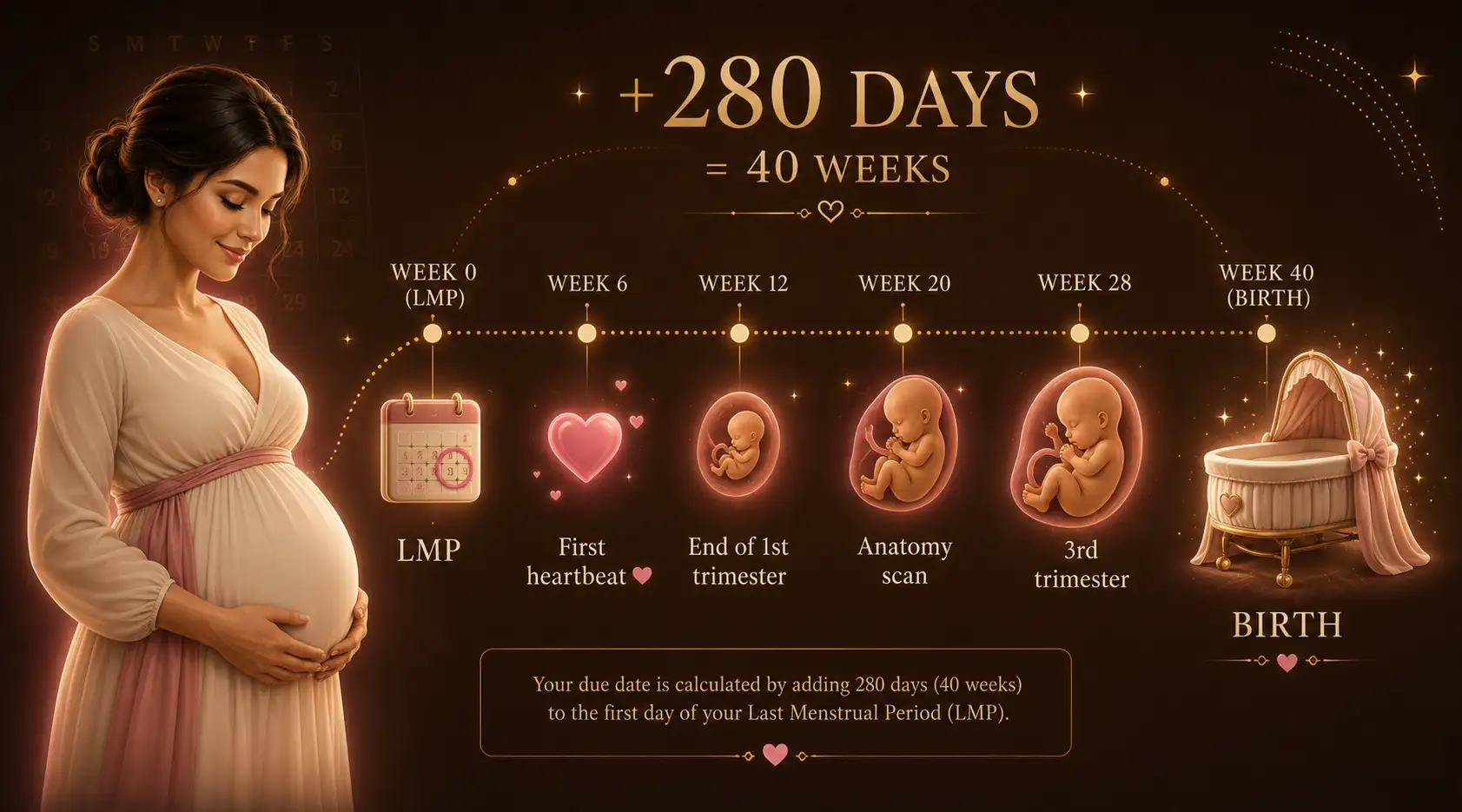
The most common method to calculate your due date is Naegele’s rule, developed by German obstetrician Franz Karl Naegele in the early 1800s. It is still the medical standard today: take the first day of your last menstrual period (LMP), add one year, subtract three months, and add seven days. The result is your estimated due date (EDD) — about 280 days (40 weeks) from the start of your last period.
5 Calculation Methods Explained
- Last Menstrual Period (LMP): The default method. Adds 280 days to the first day of your last period. Best when you have regular cycles.
- Conception Date: If you know exactly when you conceived (for example through ovulation tracking), the calculator adds 266 days to that date. Most accurate for planned conception.
- IVF 3-day Transfer: The embryo is transferred 3 days after fertilization. Add 263 days to the transfer date.
- IVF 5-day Transfer: The blastocyst is transferred 5 days after fertilization. Add 261 days to the transfer date.
- Ultrasound Dating: A first-trimester ultrasound measures crown-rump length (CRL) to estimate gestational age, then your due date is back-calculated. This is considered the most accurate method when done between weeks 8 and 13.
How Accurate Is the Due Date?
Only about 4-5% of babies are born on their exact due date. Most arrive within two weeks before or after — which is medically considered “term.” Babies born between 37 and 42 weeks are considered full-term. Your due date is a guide, not a deadline. For a complete pregnancy wellness profile, also try our free Body Shape Calculator for female to track healthy proportions throughout pregnancy. Pregnancy hormones can swing your mood unexpectedly — our free Mood Tracker helps you understand pregnancy mood changes and gives practical tips for emotional wellness.
When Does the Baby’s Heart Start Beating?
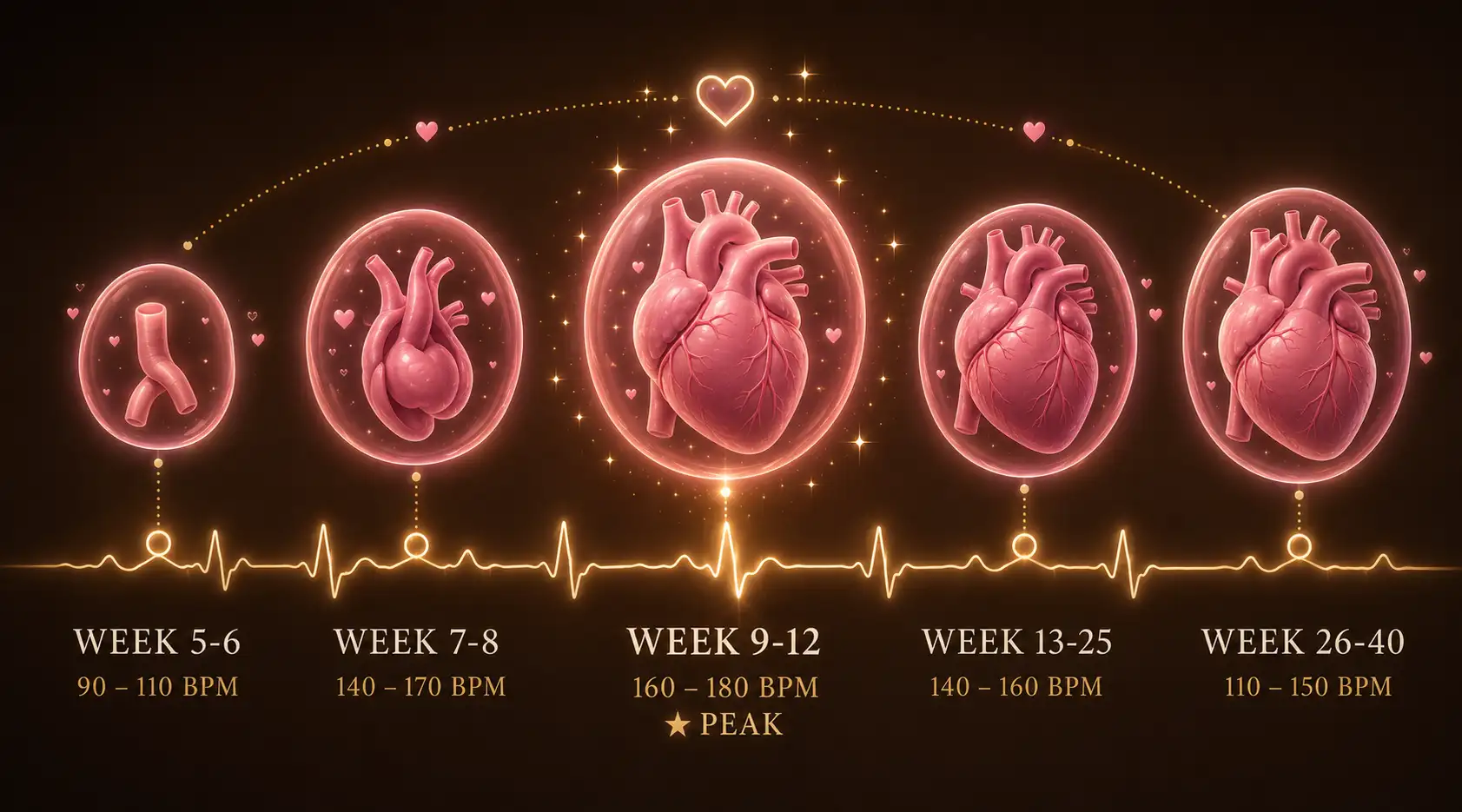
One of the most beautiful moments in early pregnancy is the first detection of your baby’s heartbeat. The fetal heart begins forming as early as week 4, and the first electrical activity — the very first heartbeat — usually starts around week 5 to 6 of pregnancy. At this stage, the heart is just a tiny tube with a steady rhythm of around 90 to 110 beats per minute.
The heartbeat is usually first detectable on a transvaginal ultrasound between weeks 6 and 7. By week 9, the heart has developed all four chambers and reaches its peak rate of 160 to 180 BPM. After this peak, the heart rate gradually settles as the baby grows — by the third trimester, the typical range is 110 to 150 BPM, closer to a newborn’s heart rate.
Pregnancy brings many beautiful changes — including subtle face shape adjustments due to swelling and hormonal shifts. Use our free Face Shape Calculator for female for hairstyle and styling tips that flatter pregnancy face changes.
What If You Don’t Hear a Heartbeat at the First Scan?
Sometimes a heartbeat isn’t detected at the first scan, especially if it is very early (before week 6) or if the baby is positioned awkwardly. This does not always mean something is wrong — your doctor will usually schedule a follow-up scan a week or two later. Always discuss any concerns directly with your healthcare provider.
Baby Heartbeat by Week — Complete Timeline
Track your baby’s expected heart rate week by week. Heart rates are general ranges from medical literature — your doctor will confirm your baby’s specific rate during ultrasound. Pair this with our free Body Shape Calculator for female to track healthy pregnancy weight gain proportions.
| Pregnancy Week | Heart Rate (BPM) | What’s Happening |
|---|---|---|
| Weeks 5-6 | 90 – 110 BPM | First heartbeat starts. Heart is a tiny tube. |
| Weeks 7-8 | 140 – 170 BPM | Detectable on ultrasound. Heart chambers forming. |
| Weeks 9-12 | 160 – 180 BPM | Peak heart rate. Four chambers fully formed. |
| Weeks 13-25 | 140 – 160 BPM | Heart rate begins to settle. Baby growing rapidly. |
| Weeks 26-40 | 110 – 150 BPM | Maturing heart rate, closer to newborn level. |
Boy or Girl by Heartbeat — Myths vs Facts
One of the most popular pregnancy myths claims that a heart rate above 140 BPM means a girl, and below 140 means a boy. This belief has been passed down for generations — but is it true?
What the Science Actually Says
Multiple peer-reviewed medical studies — including a well-known 2006 study published in the Journal of Ultrasound in Medicine — have shown that there is no statistically significant difference between male and female fetal heart rates, especially in the first trimester. The myth has been thoroughly debunked.
What Heartbeat Actually Tells You
- Pregnancy viability: A strong, regular heartbeat is one of the best indicators of a healthy early pregnancy.
- Gestational age: Combined with ultrasound measurements, the heart rate helps confirm pregnancy timeline.
- Possible concerns: A heart rate consistently outside the normal range may prompt further investigation by your doctor.
How to Find Out Baby’s Gender Reliably
For accurate gender identification, doctors use ultrasound imaging at the anatomy scan around weeks 18-20, or NIPT blood tests after week 10. Heart rate is not a reliable indicator.
Pregnancy Week-by-Week Guide
Your 40-week pregnancy journey at a glance. Each phase brings new development for your baby and changes for you. To support your wellness through pregnancy, also check our free Face Shape Calculator for female for personalized hairstyle and styling tips that flatter pregnancy face changes.
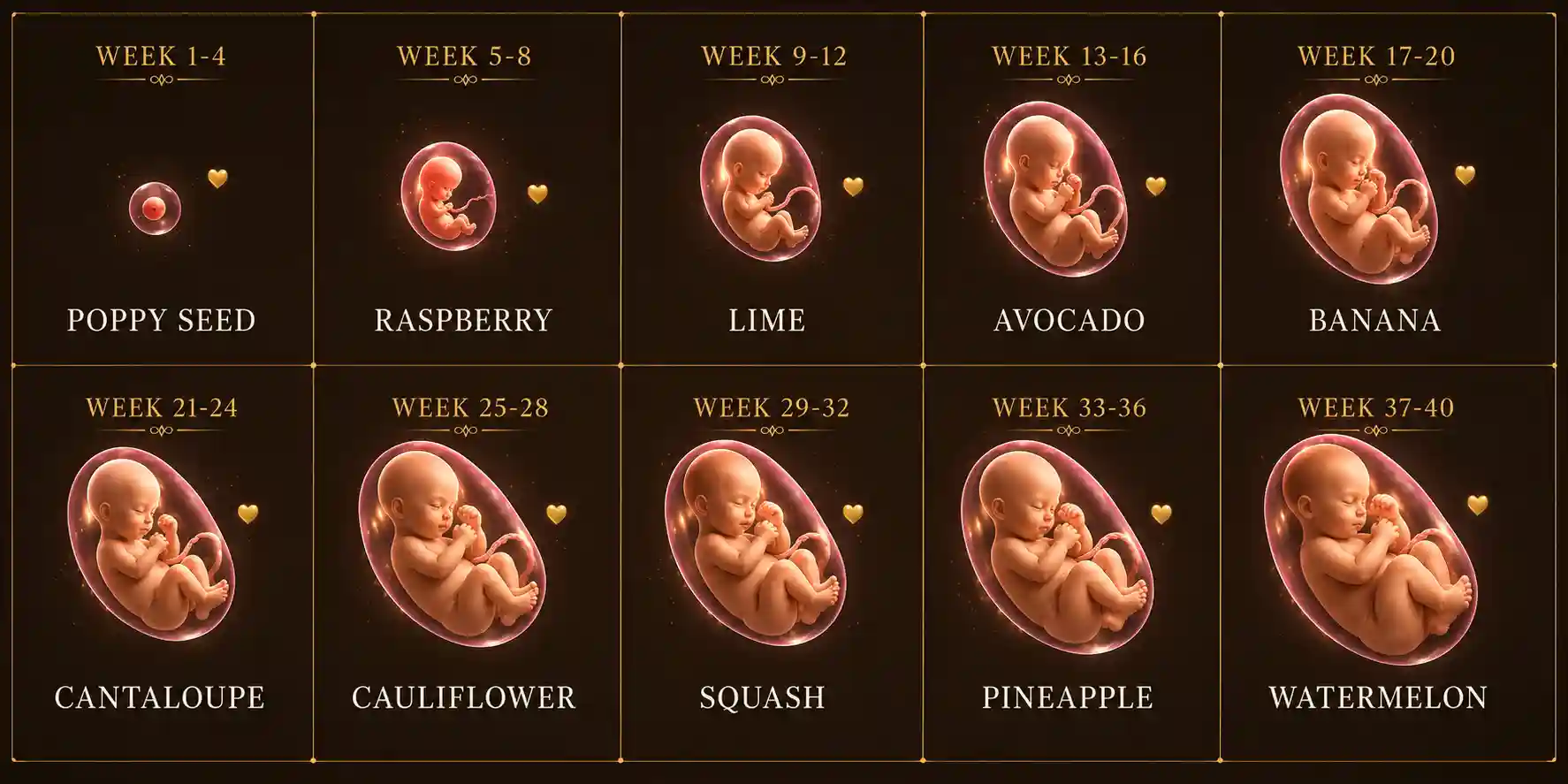
| Weeks | Trimester | Baby Size | Key Milestone |
|---|---|---|---|
| 1-4 | First | Poppy seed | Implantation, hCG rises |
| 5-8 | First | Raspberry | Heart starts beating, neural tube forms |
| 9-12 | First | Lime | All organs formed, peak heart rate |
| 13-16 | Second | Avocado | Gender visible on scan, rapid growth |
| 17-20 | Second | Banana | Anatomy scan, first kicks felt |
| 21-24 | Second | Cantaloupe | Viability milestone (24 weeks) |
| 25-28 | Third | Cauliflower | Third trimester begins, eyes open |
| 29-32 | Third | Squash | Bones harden, brain develops rapidly |
| 33-36 | Third | Pineapple | Lungs maturing, head-down position |
| 37-40 | Third | Watermelon | Full term, birth any time |
Pregnancy Trimester Guide
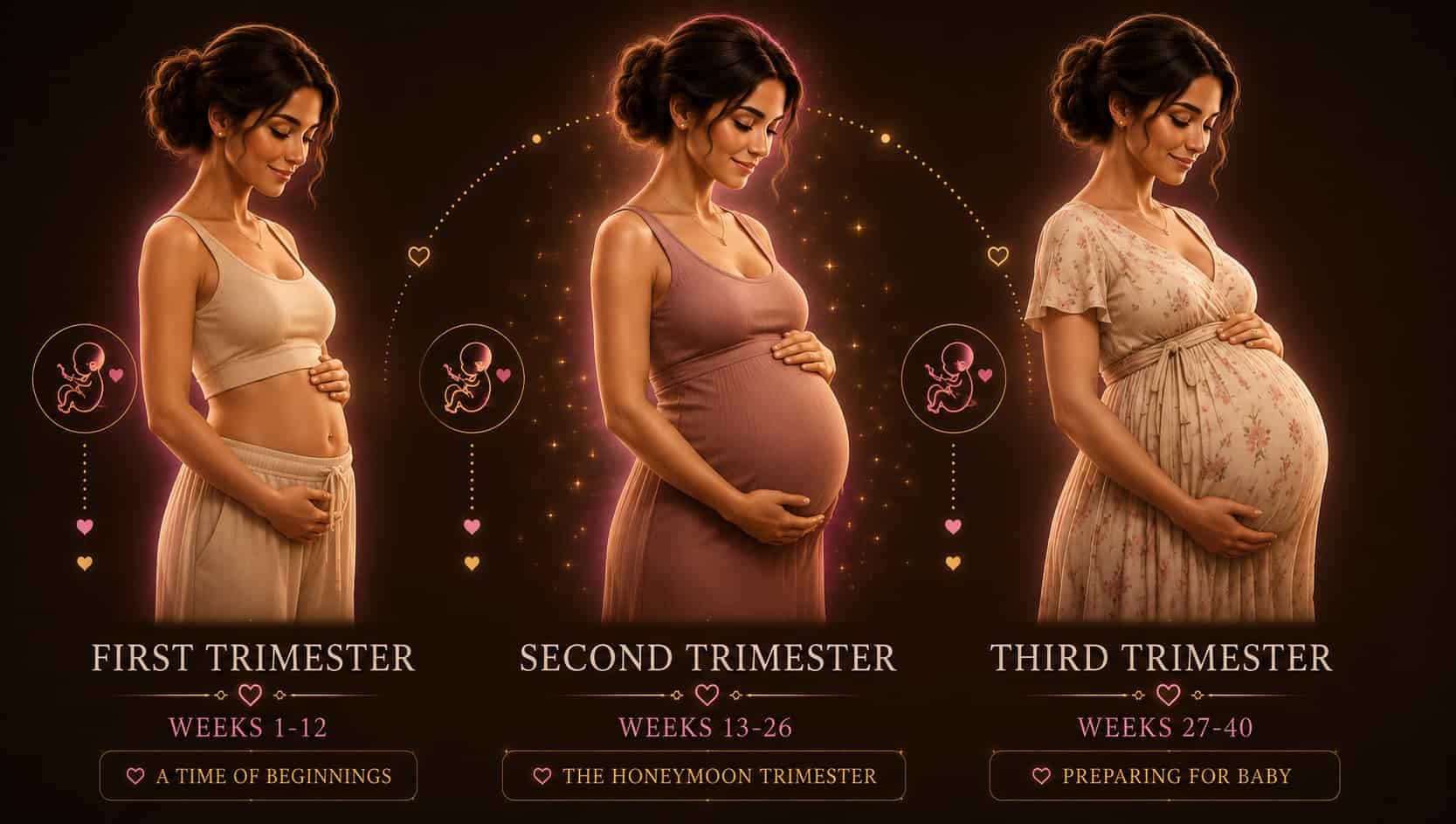
Pregnancy is divided into three trimesters, each with distinct changes for both you and your baby.
First Trimester (Weeks 1-12)
The most critical period for fetal development. All major organs form during this time. Common symptoms: morning sickness, fatigue, breast tenderness, mood swings. Key milestones: first heartbeat (week 5-6), end of organogenesis (week 12).
Second Trimester (Weeks 13-26)
Often called the “honeymoon trimester” — energy returns and morning sickness fades. Common changes: visible bump, first kicks (around week 18-22), increased appetite. Key milestones: anatomy scan (week 18-22), gender reveal possible, viability milestone (week 24).
Body shape changes most dramatically in the second trimester — track your healthy proportions with our free Body Shape Calculator as your bump grows. Emotional shifts during pregnancy are equally important — track your mood patterns with our free Mood Tracker to manage trimester-specific mood changes naturally.
Third Trimester (Weeks 27-40)
Final stretch before birth. Baby gains most of its weight in this period. Common symptoms: back pain, swelling, frequent urination, Braxton Hicks contractions. Key milestones: baby turns head-down, lungs mature, full term reached at week 37.
How to Hear Your Baby’s Heartbeat at Home
Many expecting mothers want to hear their baby’s heartbeat between doctor visits. Here are the safest, most reliable ways:
Fetal Doppler (After Week 12)
A handheld ultrasound device that detects the heartbeat through the abdomen. Reliable from week 12 onwards, when the baby is large enough. Important: home Dopplers are not as accurate as medical ones — not finding a heartbeat at home does not necessarily mean a problem.
Stethoscope (After Week 20)
A regular stethoscope can sometimes pick up the heartbeat after week 20, especially with a slim build. Place it on the lower abdomen and listen patiently. The sound resembles a fast horse gallop.
When to Worry
Always contact your doctor if you have any concerns about heartbeat or baby movement, especially in the third trimester. Reduced fetal movement, sudden changes, or persistent absence of detectable heartbeat at home should prompt a clinic visit. Never use this calculator or any home device as a replacement for professional medical assessment.
Common Questions
How accurate is the Pregnancy Due Date Calculator?
The calculator uses Naegele’s rule which adds 280 days (40 weeks) to your last menstrual period. Only about 4-5% of babies are born on the exact due date, but most arrive within two weeks before or after. For best accuracy, use a first-trimester ultrasound date if available.
When does the baby’s heart start beating?
The baby’s heart begins to form around week 4 and starts beating around week 5-6 of pregnancy at 90-110 BPM. By week 9, it reaches its peak rate of 160-180 BPM. The heartbeat is usually first detectable on a transvaginal ultrasound between weeks 6 and 7.
What is a normal fetal heart rate by week?
Weeks 5-6: 90-110 BPM. Weeks 7-8: 140-170 BPM. Weeks 9-12: 160-180 BPM (peak). Weeks 13-25: 140-160 BPM. Weeks 26-40: 110-150 BPM. These are general ranges — your doctor will confirm your baby’s specific rate during scans.
Does heartbeat predict baby’s gender?
No — this is a popular myth. Multiple peer-reviewed studies have shown there is no statistically significant difference between male and female fetal heart rates in the first trimester. Heart rate cannot be used to determine gender. For reliable gender identification, ultrasound at week 18-20 or NIPT blood test after week 10 is needed.
How is the IVF due date calculated differently?
For IVF pregnancies, the due date is calculated from the embryo transfer date — adding 263 days for a 3-day transfer or 261 days for a 5-day transfer. This is more accurate than LMP-based calculation because the conception date is precisely known.
Can I hear my baby’s heartbeat at home?
After about week 12, a fetal Doppler may detect the heartbeat at home. Around week 20, a regular stethoscope might pick it up. However, home devices are not as reliable as medical ultrasound, and not hearing the heartbeat does not necessarily mean a problem — always consult your doctor.
What are the three trimesters of pregnancy?
First trimester: weeks 1-12 (organ formation, morning sickness common). Second trimester: weeks 13-26 (energy returns, anatomy scan, first kicks). Third trimester: weeks 27-40 (rapid growth, preparation for birth).
Why does my due date change at the ultrasound?
If your ultrasound dating differs from your LMP-based date by more than 5-7 days in the first trimester, doctors typically use the ultrasound date as it is more accurate. This is normal and happens in many pregnancies, especially with irregular cycles.
When should I see a doctor about heartbeat concerns?
Always consult your doctor if you have any concerns about your baby’s heartbeat or movement, especially in the third trimester. This calculator provides general educational information only — never use it to replace professional medical assessment.
How does this calculator relate to other pregnancy tools?
This calculator gives your due date and pregnancy timeline. For complete pregnancy wellness, also try our Body Shape Calculator to track healthy pregnancy proportions, our Face Shape Calculator for styling tips, and our Mood Tracker for understanding pregnancy mood changes with personalized wellness tips.
Discover 10 More Free Tools
Explore our collection of free, fast and easy-to-use online calculators — built for daily use on mobile and desktop.